The Money Is Moving – And It Is Moving to Niche
If you have been following where venture capital is flowing in 2026, one pattern stands out clearly above the rest.
Investors are not just throwing money at AI in general. They are specifically chasing software companies that go deep into one industry and solve problems that nobody outside that industry fully understands.
Two deals from the last week of May 2026 made this crystal clear.
Corgi, a full-stack commercial insurance platform, raised a $106 million Series B at a $2.6 billion valuation. They are building software specifically for the insurance industry – not software that kind of works for insurance with a few tweaks. Software that speaks the language of insurance from the ground up.
Saris, an AI workflow automation tool built exclusively for banks and credit unions, raised a $28.8 million Series A. Their AI agents are now automating up to 70% of lending, compliance, and operations tasks at financial institutions – the kind of complex, regulation-heavy work that general-purpose automation tools have never been able to touch.
These are not isolated deals. They are part of a pattern that has been building for a while and is now impossible to ignore.
Vertical SaaS – software built for one specific industry – is having its moment. And if you are a founder, an investor, or even just someone trying to understand where tech is headed, this is the trend worth paying the most attention to right now.
Let’s Start From the Beginning – What Is Vertical SaaS?
If you are not deep in the SaaS world, the term vertical SaaS might sound like jargon. Let me explain it simply.
There are two broad types of business software:
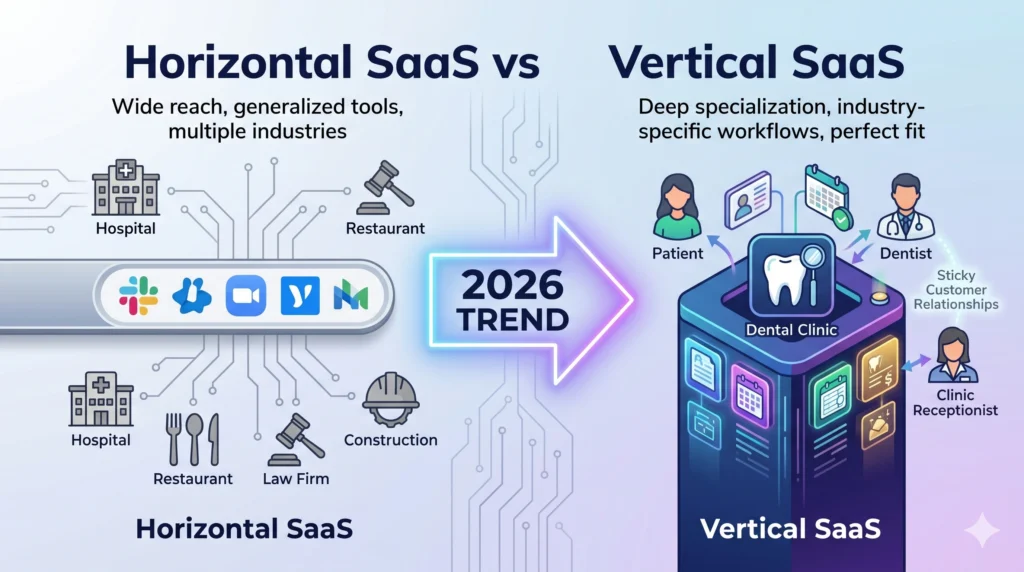
- Horizontal SaaS is software built for everyone. Think tools like Slack, Zoom, or Google Workspace. It does not matter if you are a hospital, a law firm, a restaurant, or a construction company – you can use these tools. They are designed to be flexible enough to fit any business.
- Vertical SaaS is software built for one specific type of business or industry. A platform built just for dental clinics. Software designed only for commercial real estate brokers. A tool built exclusively for credit unions. These products are not trying to be useful for everyone – they are trying to be absolutely essential for one group.
The trade-off is obvious. Horizontal software has a bigger potential market. But vertical software has something more valuable in the long run: it fits its customers so well that those customers almost never want to leave.

Why Is Vertical SaaS Winning Right Now?
The shift toward vertical SaaS is not random. There are real reasons why investors and customers are preferring it in 2026 over the general-purpose alternatives.
Every Industry Has Its Own Language
Here is something that sounds simple but has massive implications for software: every industry has its own terminology, its own workflows, its own compliance requirements, and its own way of doing things.
A commercial insurance company does not think about customers the same way a retail company does. They think about policyholders, premiums, endorsements, loss ratios, and underwriting guidelines. They deal with state-by-state regulatory requirements that change constantly. They manage claims processes that have dozens of steps and involve multiple parties.
A generic CRM or a general-purpose workflow tool can be stretched and customized to sort of handle these things. But “sort of” is not good enough when your business depends on it. And the cost of training your team on a generic tool, customizing it, maintaining those customizations, and updating them every time the generic platform changes – it adds up fast.
Vertical SaaS arrives knowing the language already. The fields are labeled correctly. The workflows match what your team actually does. The compliance features are built in, not bolted on. The time to value is dramatically shorter.
Switching Costs Are High – In a Good Way
For vertical SaaS companies, customer retention is much easier than it is for horizontal tools.
When a company switches from one project management tool to another, the pain is mainly about learning a new interface and migrating data. Annoying, but manageable.
When a bank switches from one core banking platform to another, or when an insurance company changes the software that runs its entire underwriting process – that is a massive, expensive, multi-year undertaking. The switching cost is enormous.
This is called a “sticky” product in the startup world. Once a vertical SaaS company gets inside a customer’s core operations, they tend to stay there for a very long time. That means predictable revenue, low churn, and a business that compounds beautifully over time.
Investors love that combination.
AI Is Finally Cracking Industries That Were Too Complex Before
Here is the new ingredient that is making 2026 a particularly explosive moment for vertical SaaS specifically: AI.
For years, certain industries were considered too complex, too regulated, or too specialized for software to truly transform. Insurance. Banking. Legal. Healthcare. Construction. These are sectors where the rules are complicated, the consequences of errors are serious, and the processes require a level of contextual understanding that generic software just could not provide.
AI is changing that calculus.
Take Saris as an example. They are automating up to 70% of lending, compliance, and operations tasks at banks and credit unions. Think about what that actually means. Loan applications involve checking credit history, verifying income, assessing risk, ensuring regulatory compliance across multiple jurisdictions, generating documents, getting approvals – a web of interconnected steps that used to require a team of specialists working for days.
AI agents trained specifically on banking workflows and regulations can now handle most of that automatically. Not a generic AI assistant – a purpose-built AI that understands the specific language, rules, and requirements of financial services.
That is the combination that is attracting big money: deep industry expertise plus modern AI capabilities equals a product that can genuinely transform how an entire sector operates.
Breaking Down the Two Big Deals
Let’s look more closely at what Corgi and Saris are actually doing, because the details tell a bigger story.
- Corgi – Reinventing Commercial Insurance from Scratch
Commercial insurance is, by most measures, a sector that has been underserved by technology for decades. The industry runs on a strange mix of legacy systems, manual processes, spreadsheets, and phone calls. Getting a quote for a complex commercial policy can take days or weeks. Policy management is fragmented across multiple systems. Claims processing is slow and painful.
Corgi came in and built a full-stack platform – meaning they are not just putting a nice interface on top of old infrastructure. They rebuilt the whole thing. Quoting, binding, policy management, claims – all in one modern system.
Their $106 million raise at a $2.6 billion valuation, just weeks after their previous funding round, tells you investors believe this kind of deep rebuild can work. And they are expanding into trucking, small business, and sports insurance – each of which is its own specialized vertical within the broader insurance world.
That is the playbook for the best vertical SaaS companies: go deep in one area, prove you can dominate it, then expand into adjacent niches where your core expertise still applies.
- Saris – Making Banks Move at Startup Speed
Banks and credit unions are not known for moving fast. They carry enormous regulatory burdens, run on legacy core systems that are often decades old, and have compliance teams that review every process change carefully.
Saris went into this environment and built AI agents that understand these constraints from the inside. Their agents automate lending workflows, compliance checks, and back-office operations – not by ignoring the regulations, but by encoding them into the agent’s behavior.
The result is that a credit union using Saris can process loan applications faster, reduce compliance errors, and free up their human staff to focus on the work that actually requires human judgment: building relationships with members, handling complex cases, making decisions in unusual situations.
A $28.8 million Series A is real money and reflects genuine investor conviction that this approach works. Integration with platforms like Fiserv and Encompass – the core infrastructure that most banks already run on – means Saris slots into existing operations rather than asking customers to rip everything out and start fresh.
That is smart product strategy. Meet customers where they are.
What This Means for Founders
If you are thinking about building a SaaS company in 2026, the lesson from the vertical SaaS funding wave is fairly clear.
Picking a specific industry is not limiting – it is a competitive advantage.
A lot of first-time founders resist going narrow. They worry that if they build something for dental clinics, they are leaving money on the table by not also serving veterinary clinics, optometrists, and general practitioners. The instinct is to maximize the potential market.
But that thinking gets the logic backwards. When you go deep on one industry, you build something that truly fits that industry. Your marketing is clearer. Your product roadmap is more focused. Your sales team can develop genuine expertise. Your customers refer you to others in their industry because you actually understand their world.
And here is the thing about market size – a vertical that seems small at first often turns out to be bigger than you thought once you really get inside it. Commercial insurance is a multi-trillion dollar industry globally. Banking and financial services is even larger. Even something as specific as trucking insurance or sports industry compliance software can be a substantial market if you execute well.
The best opportunities are often in industries people find boring or complicated.
Insurance. Legal. Construction. Agriculture. Healthcare administration. These are not the glamorous sectors that attract a lot of first-time founders. They are complicated, regulation-heavy, and full of legacy systems that make integration harder.
That is exactly why the opportunity is there. The less glamorous and more complicated an industry is, the fewer people have tried to fix it – and the more room there is for a team that is willing to do the hard work of truly understanding it.
You do not have to build everything yourself.
One of the patterns in the most successful vertical SaaS companies is that they integrate deeply with the existing software and infrastructure that their target industry already uses. Saris integrates with Fiserv and Encompass. Corgi connects with existing insurance data sources and carrier systems.
The goal is not to replace everything overnight. It is to make the new thing work seamlessly with the existing thing, so customers can adopt it without disrupting their whole operation. That reduces the barrier to adoption dramatically.
What This Means for Investors
If you are an investor looking at the SaaS landscape in 2026, vertical SaaS should be high on your radar – and by the look of recent deal flow, it already is for the sophisticated funds.
The metrics on vertical SaaS companies tend to look very attractive compared to horizontal alternatives. Customer retention is higher. Expansion revenue (getting existing customers to spend more over time) is more predictable. The path to becoming genuinely essential infrastructure in an industry – rather than just a nice-to-have tool – is clearer.
The risk, of course, is that the market size is more constrained than a horizontal tool. You need to believe that the industry you are targeting is large enough to support the business you want to build, and that the company has the right go-to-market strategy to capture a meaningful piece of it.
But for investors who are tired of betting on general-purpose AI tools in a market that is getting very crowded very fast, vertical SaaS offers something different: a defensible niche, a specific customer base that can be deeply understood, and the kind of sticky product dynamics that make for very durable businesses.
The Bigger Picture
What is happening with vertical SaaS is really a story about the maturation of software.
In the early days of cloud software, just getting businesses to use any kind of modern software was the challenge. Basic tools for communication, project management, and file storage were transformative because most businesses were still running on paper and desktop software.
That phase is over. Nearly every company already uses software for most of its operations.
The new challenge is that most of that software is generic – it works well enough but does not truly fit the way any specific industry operates. The next wave of value creation in software is about replacing “good enough” with “built exactly for this.”
Corgi and Saris are examples of that next wave. And based on where the funding is going, they are far from the last.
Quick Summary
- Vertical SaaS – software built specifically for one industry – is attracting massive venture capital in 2026.
- Corgi raised $106M at a $2.6B valuation to transform commercial insurance with full-stack modern software.
- Saris raised $28.8M to automate up to 70% of lending, compliance, and operations at banks and credit unions using AI agents.
- Vertical SaaS wins because it speaks the native language of its industry, creates very sticky customer relationships, and now has AI to tackle problems that were previously too complex to automate.
- For founders: going narrow is a strength, not a limitation – especially in boring, complicated industries most people avoid.
- For investors: vertical SaaS offers better retention, more predictable expansion revenue, and genuine defensibility.
Are you building in a specific vertical, or thinking about it? What industry do you think is most underserved by software right now? Drop your thoughts below.