
Something Big Just Happened in the World of Software
On May 27, 2026, a company called Cognition raised over one billion dollars.
That alone would be a big deal. But the reason why investors poured that kind of money into Cognition is what made the whole tech world stop and pay attention.
Cognition builds AI agents that write software. Not tools that help developers write code faster. Not autocomplete on steroids. Actual autonomous agents that receive a task, figure out how to complete it, and ship working code – without a human engineer sitting there guiding every step.
Their product, Devin, is now writing over 90% of the code inside Cognition’s own company. And it is being deployed at Goldman Sachs, Mercedes-Benz, NASA, and Santander. Their revenue has grown 13 times year over year, hitting a run rate of $492 million.
At a $26 billion valuation, investors are clearly betting this is not a gimmick. This is the future.
So what does this actually mean? For developers, for companies, for the entire software industry – let’s talk about it honestly.
What Even Is an AI Coding Agent?
Before we get into the business side of things, let’s make sure we are all on the same page about what an AI coding agent actually is – because it is very different from the AI coding tools most people have used so far.
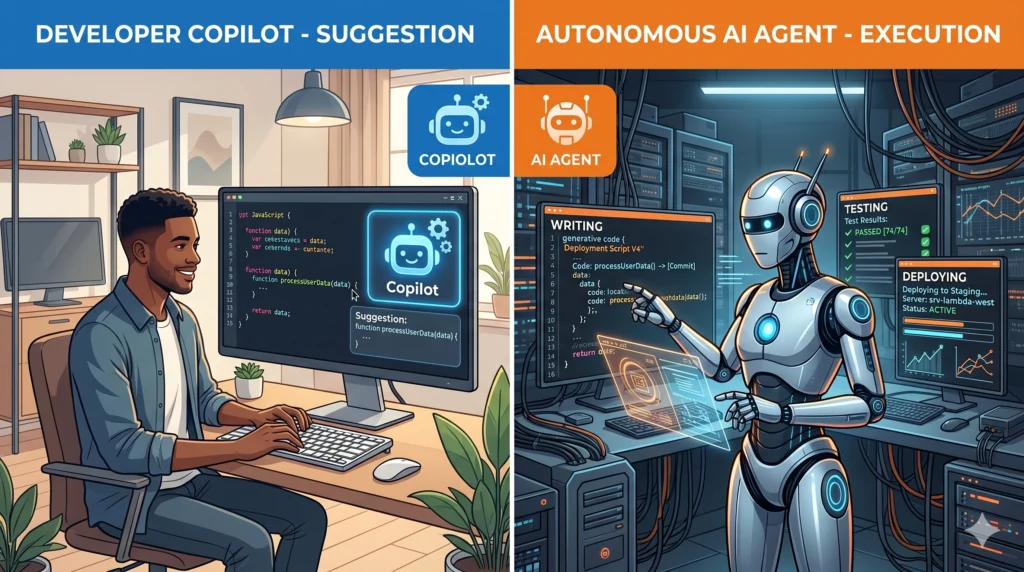
- Tools like GitHub Copilot – which came out a few years ago – were helpful assistants. You are writing code, and they suggest the next line or the next block. You still make every decision. The AI just speeds up your typing.
- AI coding agents are different. You give them a goal. Something like: “Build me a login system with two-factor authentication and add it to the existing codebase.” And then the agent goes off and does it. It reads the existing code, understands the context, writes new code, tests it, fixes errors, and comes back with a finished result.
It is the difference between having a very smart autocomplete and having a junior developer on your team who can actually execute tasks independently.
That gap – between suggestion and execution – is what has changed everything.

Why Are Investors Throwing Billions at This?
When you look at where the big money is going in tech right now, AI coding tools are at the very top of the list. And the reason is pretty straightforward once you think about it.
Software development is one of the most expensive things a company does. A good senior engineer in a major tech hub can cost a company $300,000 to $400,000 a year when you factor in salary, benefits, equity, and overhead. And you usually need a lot of them.
Now imagine a tool that can do a significant portion of that work at a fraction of the cost – and it does not take vacation, does not burn out, and gets better every month.
That is an enormous business opportunity. Investors are not just betting on Cognition and Devin. They are betting on a fundamental shift in how software gets made. And they want to be positioned before that shift fully arrives.
The companies building these tools are essentially selling efficiency at a massive scale. Every company on the planet that builds software is a potential customer.
Who Is Actually Using These Tools Right Now?
This is where it gets really interesting. The early adopters of autonomous AI coding agents are not small startups experimenting with new toys. They are some of the biggest, most serious organizations in the world.
Goldman Sachs is one of the most risk-averse financial institutions on the planet. They have armies of compliance officers and legal teams reviewing everything. The fact that they are deploying Devin internally tells you something important – this technology has cleared serious scrutiny.
- NASA is using it. An organization where software bugs can literally be life-or-death situations is trusting AI agents to contribute to their codebase. That is a statement.
- Mercedes-Benz is using it. Car software is incredibly complex and safety-critical. Again, not the kind of organization that takes chances on unproven technology.
- Santander, one of the largest banks in Europe, rounds out the list.
These are not companies chasing trends. These are companies that have looked at the technology, tested it carefully, and decided the return on investment is real.
What Does This Mean for Software Developers?
Let’s be honest about this part, because it is the question everyone is really asking.
Are AI coding agents going to replace software engineers?
The short answer is: not entirely, and not right away. But the longer answer is more complicated – and developers who ignore what is happening are making a mistake.
Here is how I see it playing out:
The work that is going away
Repetitive coding tasks – writing boilerplate code, building CRUD apps, setting up standard API integrations, writing unit tests for straightforward functions – this kind of work is increasingly being handled by AI agents. And they do it faster and more consistently than most junior developers.
If your value as a developer is mainly in executing well-defined tasks that follow a pattern, that role is under real pressure.
The work that is not going away (yet)
Complex system design, understanding ambiguous business requirements, making architectural decisions that need to hold up for years, security thinking, creative problem-solving when something truly novel needs to be built – these things still need experienced human engineers.
AI agents are very good at execution. They are not yet great at judgment. They do not understand your company’s politics, your technical debt situation, your team’s skill gaps, or the million other invisible factors that good senior engineers account for.
What smart developers are doing
The engineers who are thriving right now are the ones treating AI coding agents as their best tool – not their replacement. They are using agents to handle the tedious parts of their work so they can focus on the parts that require real thinking.
Think of it like this. When calculators arrived, mathematicians did not disappear. They just stopped spending time on arithmetic and started spending more time on the hard problems. The same shift is happening now.
The Top AI Dev-Tool SaaS Companies to Watch in 2026
Cognition and Devin are getting the most headlines right now, but they are not alone. Here is a quick look at the space:
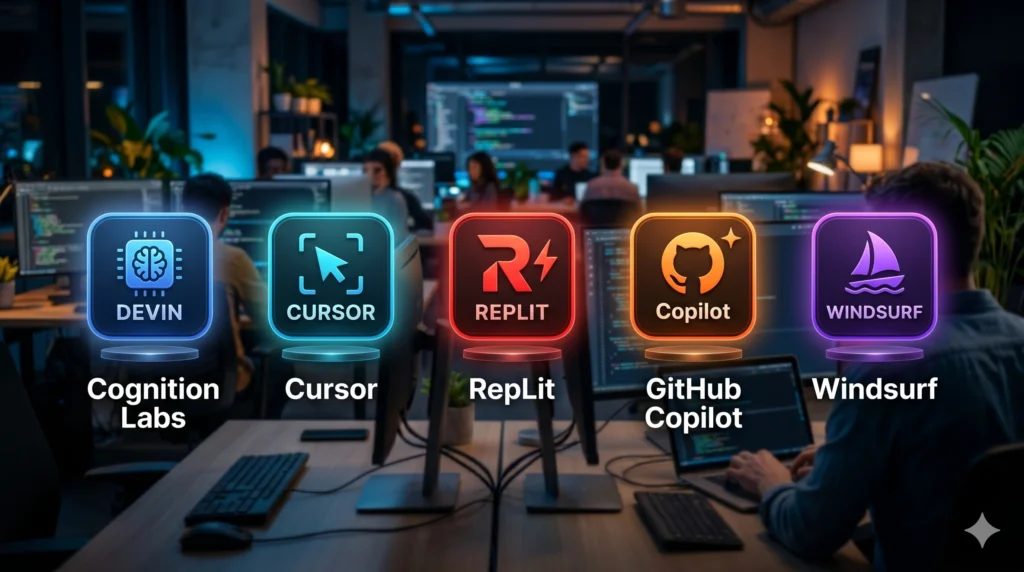
- Cognition / Devin – The leader right now in fully autonomous software engineering agents. As mentioned, they are already operating at serious enterprise scale with household-name clients.
- Cursor – An AI-powered code editor that has built an enormous following among professional developers. Rather than full autonomy, Cursor focuses on keeping the developer in control while making them dramatically faster. Very popular with startups.
- Replit – Has been pushing hard into AI-assisted development and agentic coding, particularly popular among newer developers and people building smaller projects.
- GitHub Copilot (Microsoft) – Still one of the most widely used AI coding tools in the world. Microsoft has been steadily adding more agentic capabilities. The distribution advantage of being built into GitHub gives them a reach no startup can easily match.
- Windsurf (Codeium) – A newer entrant making noise with strong reviews from developers who want something between Copilot’s suggestion model and Devin’s full autonomy.
Each of these is taking a slightly different approach to the same big problem: how do you use AI to make software development faster, cheaper, and more accessible?
What Should Companies Be Thinking About Right Now?
If you run a company that builds software – or that relies on a team of developers – here are the questions worth sitting with:
- Are you experimenting with these tools? If your engineering team has not at least tried AI coding agents, you are falling behind. Not because every tool is ready for production, but because understanding the capabilities and limitations requires hands-on experience. Get your team experimenting now.
- What is your plan for the cost savings? If AI agents genuinely reduce development time by 30%, 50%, or more – where does that value go? Do you ship more? Do you reduce headcount? Do you reinvest in design and strategy? These are real decisions that leadership teams need to start thinking through.
- What are your quality and security controls? AI-generated code is not always correct. It can introduce bugs, and occasionally it can introduce security vulnerabilities. Companies adopting these tools seriously need robust review processes in place. The technology is powerful, but it is not foolproof.
- How are you thinking about your engineers? The best engineers right now are being energized by these tools – they get to spend less time on boring work and more time on interesting problems. But some engineers are anxious. Clear, honest communication from leadership about how these tools will be used in your organization goes a long way.
The Bigger Picture
What is happening with AI coding tools is not just a story about software development. It is a story about what happens when the cost of producing something valuable drops dramatically.
When printing presses made books cheap to produce, it did not kill writing – it created an explosion of writing. When digital music tools made recording accessible, it did not kill musicians – it created an explosion of music.
When AI agents make software cheap to produce, my bet is we do not get less software. We get an explosion of software. More products, more ideas, more small teams building things that used to require large engineering departments.
The question is not whether AI coding agents will change software development. They already are. The question is whether you and your organization are paying close enough attention to catch the wave rather than get knocked over by it.
Quick Summary
- Cognition raised $1B+ at a $26B valuation for Devin, an AI agent that autonomously writes software.
- AI coding agents are different from tools like Copilot – they execute full tasks, not just suggest code.
- Major enterprises including Goldman Sachs, NASA, Mercedes-Benz, and Santander are already deploying these tools.
- Developers doing repetitive, well-defined coding work face real pressure. Senior engineers with judgment and design skills are safer – for now.
- The smart move is to use these agents as powerful tools, not fear them as competitors.
- Companies need to start experimenting, and fast – falling behind here is a real risk.
Are you using AI coding agents in your work? What has your experience been? Share in the comments – I would genuinely love to hear what is working and what is not.