Out of nowhere, numbers change on a screen during meetings. Picture leading twenty folks who dial customers, write messages, give product walkthroughs every day. Yet when the calendar flips, results feel like luck more than logic. A teammate adjusts figures in a shared file, voices echo around a table. Truth hits – predictions rest on hunches, patched together with hope. Deals vanish without warning. Closings seem random, almost accidental.
This is precisely what Gong aims to solve. Which explains the importance of reading this review today.
What if a tool could show exactly how your sales talks are going? Gong says it can, by tracking every word spoken during customer calls. Instead of guessing, artificial intelligence spots patterns – like which phrases help close wins or push buyers away. Some say it changed how teams sell; others stay skeptical. Big companies such as LinkedIn, Shopify, and Slack have used it for years. Around five thousand businesses now rely on its data. Yet questions remain: Is it still effective in 2026? Could your group truly benefit – or would it just add noise instead?
Starting off, this piece explains Gong’s purpose. Its main tools? They function by tracking customer interactions. Price details come next – actual numbers, not estimates. People using it day to day mention certain drawbacks; those are included here. Some teams will find it useful. Others might be better served somewhere else.
What Is Gong and What Does a Revenue Intelligence Platform Actually Do?
Here’s how it works. Picture software listening in as sellers talk to buyers – calls, emails, meetings – all recorded without extra steps. From those moments, artificial smarts spot what keeps happening across talks. Memory gaps? Missing updates in sales logs? Gone. Real words from real chats shape next moves. Decisions grow from actual back-and-forth, not guesses typed after the fact.
Back in 2015, two people named Amit Bendov and Eilon Reshef began Gong. Because it focused on how talk happens during sales meetings, it quickly stood out. Instead of guessing, companies could now pull real data from recorded conversations. Once captured, those talks get turned into text without losing meaning. With enough calls stored, trends start showing up clearly. Maybe the best performer asks a certain question early – while others skip it. Or perhaps stalled deals share a common pushback heard again and again. Hidden gaps like these become visible only when you look across many interactions. Who really talks more in your meetings – people or silence? With Gong, that guesswork fades fast.
Little by little, it grew past just saving calls. Now comes deal monitoring, predictions on outcomes, support for guiding reps, then – last – a shift toward smart helpers handling routine tasks such as updating records or fixing sales flow gaps.
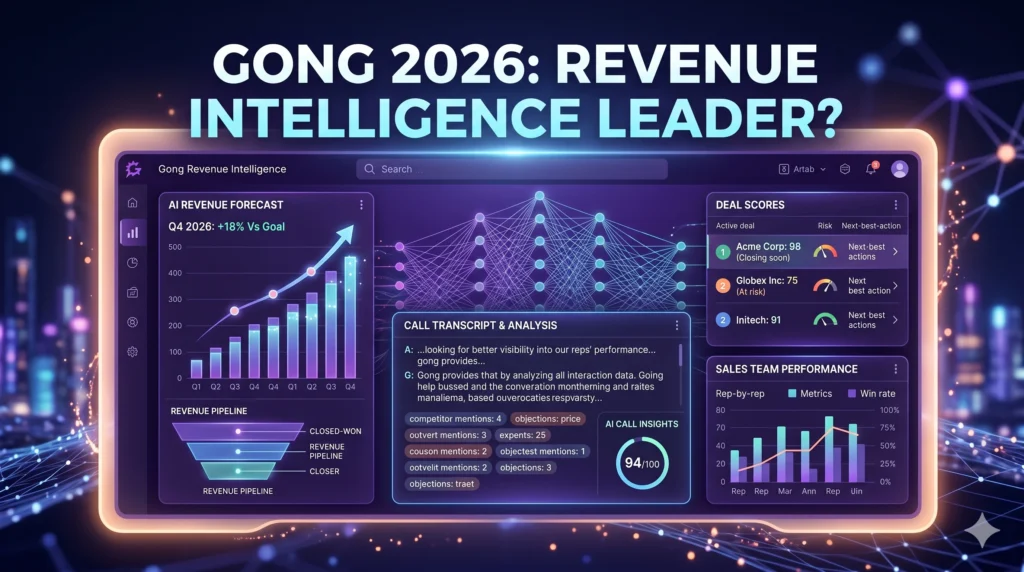
Right now, the main thing Gong builds is named the Revenue AI Operating System. Sounds heavy, yet here’s how it actually works: once linked to calls, emails, and meetings, it gathers each conversation. Then comes the shift – data flows into an artificial intelligence system that tracks deal progress, spots warning signs, guiding supervisors on where help might be needed next.
Who Uses Gong?
Sales groups focused on big business clients usually gain the most from using Gong. Picture software firms where deals take half a year or more to close, involve several people making choices together, with agreements costing far more than fifty thousand dollars. When these teams overlook cues during talks – such as a buyer bringing up another vendor or someone influential stopping communication – it might cost them a major opportunity. The purpose of Gong is spotting those exact points just in time to prevent missed income.
It takes fewer people, basic offerings, short deals – yet gains little extra. That happens when there isn’t much tangled detail to sort through. Getting things correct matters less when the stakes stay low.
Gong Review: The Core Features That Actually Matter
Conversation Intelligence
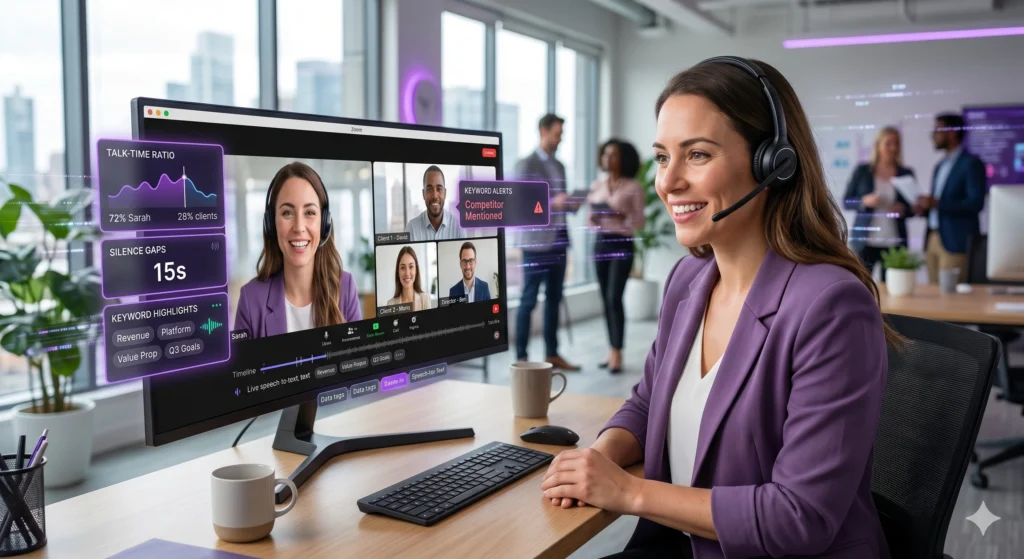
Most folks know Gong because of this feature – remains its standout strength today. A sales conversation on Zoom, Google Meet, or Teams gets joined by Gong without anyone lifting a finger; recording and transcription kick off right away. Transcripts come out correct about 85 to 90 percent of the time, even when people speak with varied accents – decent, though not perfect. Telling who said what? That part functions smoothly, clearly showing talk-time between seller and buyer.
Most people overlook how much silence can reveal. A seller talking three-quarters of a call stands out when high achievers speak less than half. That gap? It becomes something real to work on. Quiet moments start making sense once numbers show who leans too heavy.
You can also set up keyword trackers. If competitors get mentioned in calls, Gong flags those calls for review. If pricing comes up early, it tracks that too. Sales managers can search across all call transcripts like a search engine, which makes finding specific moments in thousands of calls actually practical.
Here’s something useful to remember: AI doesn’t always catch subtle cues. When sarcasm slips in, or pauses carry meaning, or expressions depend on cultural context – it might miss the mark. A prospect saying “that’s interesting” without enthusiasm could sound engaged to software, but not to a seasoned ear. Judgment matters more than data points. Watching recordings helps spot what numbers overlook.
Deal Intelligence
Beyond individual calls, Gong tracks deal health across the entire pipeline. It pulls data from over 300 signals, things like how often meetings are happening, whether key stakeholders have gone silent, whether a competitor got mentioned in the last three calls, and whether the deal has been stuck in the same stage too long.
The Deal Likelihood Score, which Gong generates for each open opportunity, uses all of those signals to flag which deals need attention. For a sales manager with 40 active deals to watch, this is practically useful. Instead of reviewing every deal equally, you can focus on the ones the AI is flagging as at risk.
One team at a SaaS company I read about shifted their forecast accuracy from 65 percent to closer to 89 percent after implementing Gong’s deal tracking alongside their CRM data. That’s a meaningful improvement for a leadership team that needs to make hiring and spending decisions based on projected revenue.
Forecasting
Gong Forecast pulls from actual sales activity rather than relying only on what reps manually enter into the CRM. This matters because rep-submitted forecasts are notoriously optimistic. Reps tend to keep deals “active” in the pipeline long after they’ve gone cold. Gong’s forecast module adjusts projections based on real conversation data and signals, which generally produces more realistic numbers.
This feature is a separate add-on, though. It’s not included in the base Foundation plan. You pay extra for it, and the pricing adds up faster than the initial quote suggests.
Coaching and Enablement
Gong lets managers create scorecards, pull specific call snippets, and share them with reps for review. You can set benchmarks based on what top performers do differently, then measure every rep against those benchmarks automatically.
For a new sales hire, being able to listen to 20 examples of a top rep handling a specific objection is far more useful than a training slide deck. Gong makes that kind of library available, and it updates continuously as new calls come in.
The catch is that this only works if someone in the organization actually builds the coaching programs. Several users in reviews I came across mentioned that Gong became an expensive call recording tool at their company because no one was systematically using the coaching data. The platform doesn’t run itself.
Gong AI Agents
In 2025 and 2026 Gong expanded significantly into AI agents. The Data Extractor agent pulls information from call transcripts and automatically updates CRM fields, which closes a major gap where reps were expected to manually log notes after every call. The Deep Researcher agent handles more complex questions across large sets of interactions.
These are genuine improvements because they push Gong from passive analysis into actually doing things in your workflow. Whether they work well depends a lot on how clean and well-structured your underlying CRM data already is.
What Does Gong Actually Cost in 2026?
Truth hits hardest here – Gong’s costs draw repeated complaints, fairly so. What stands out isn’t just the price tag but how often it becomes a sticking point.
Pricing details? Gong keeps those behind closed doors. Each offer comes tailored, hammered out one-on-one with a sales rep. Numbers floating around come from real purchase records – verified feedback pulled from actual users, pieced together from several places. What follows lines up close to that picture.
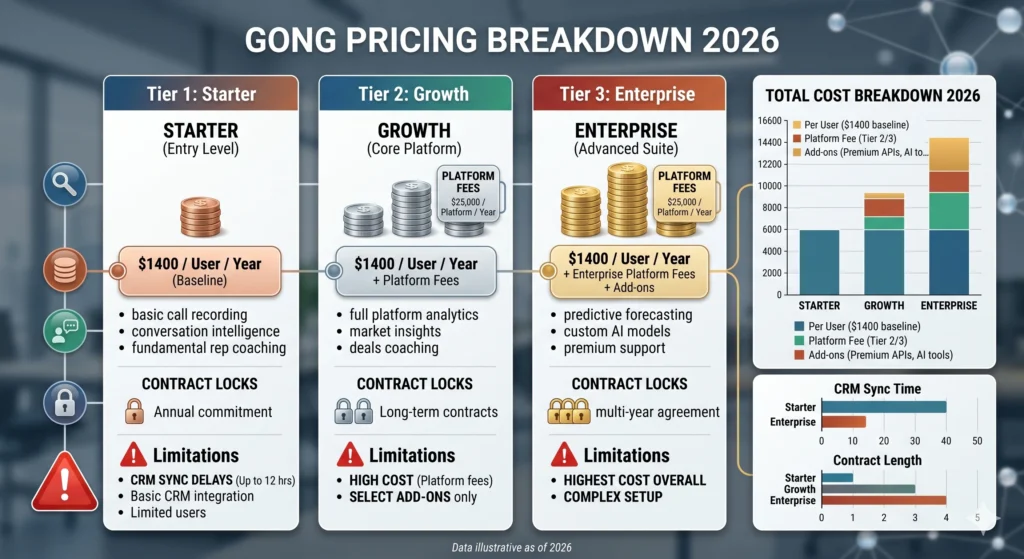
Starting at roughly $1,400 yearly each person, the entry option sets a baseline. Before extra charges even kick in, another layer shows up. Small groups face an unavoidable platform charge beginning near $5,000 annually. Big companies might pay as much as fifty grand every year just to run it. Even if only one seat gets purchased, that price stays fixed. Split among ten users? Each ends up carrying an added five hundred bucks beyond their individual rate. All of this stacks up long before specific tools enter the picture.
Add-on modules stack further. Gong Forecast is roughly $300 to $700 per user per year. Gong Engage, their outbound sequencing tool, is around $800 per user per year but requires a Foundation license for every user, so you can’t buy Engage without paying for Core too.
For a 25-person sales team buying Foundation plus Forecast, you’re looking at somewhere around $92,000 to $115,000 in year one, once you include the platform fee and onboarding costs.
Contracts are annual at minimum. Multi-year contracts of two to three years are the norm and unlock modest discounts, but they also lock you in with auto-renewal uplifts of 5 to 15 percent per year. Early exit penalties reportedly run 50 to 100 percent of remaining contract value.
You also can’t easily downsize mid-contract. If you bought 30 seats and four people leave, you’re still paying for 30 seats until renewal.
For teams under about 20 reps, the math is genuinely hard to make work unless your average deal size is large enough that saving even a small number of deals per year offsets the platform cost.
The Real Limitations: What Users Actually Report
The Gong Review picture wouldn’t be complete without the parts that frustrate people.
The buying experience itself is a source of complaints. There’s no self-serve trial. You fill out a form, a sales rep calls you, and you go through a full sales process before you can really understand how the product works in your environment. Several reviews describe that gap between what the demo looked like and what daily use actually felt like as significant. One review I came across described it as not finding out what it actually feels like until you’re already locked in.
The CRM integration situation is complicated. Gong works well with Salesforce. For HubSpot users, the experience is much rougher. Some integrations that Salesforce customers take for granted don’t exist for HubSpot, and teams on that CRM often end up manually pushing data across, which defeats a big part of the purpose.
CRM sync also has a latency issue for some teams. Gong’s own documentation notes that syncing data can take up to 30 minutes. For fast-moving sales environments where a manager needs a current view during a pipeline review call, that delay creates frustration and sometimes leads to side spreadsheets that weren’t supposed to exist anymore.
Data portability is another friction point. Multiple users report that years of call recordings and transcripts are essentially locked inside Gong’s interface. Export options are limited, API access for pulling data into BI tools is gated behind higher tiers, and getting your own data out cleanly is harder than it should be.
Gong vs. Alternatives: The Honest Comparison
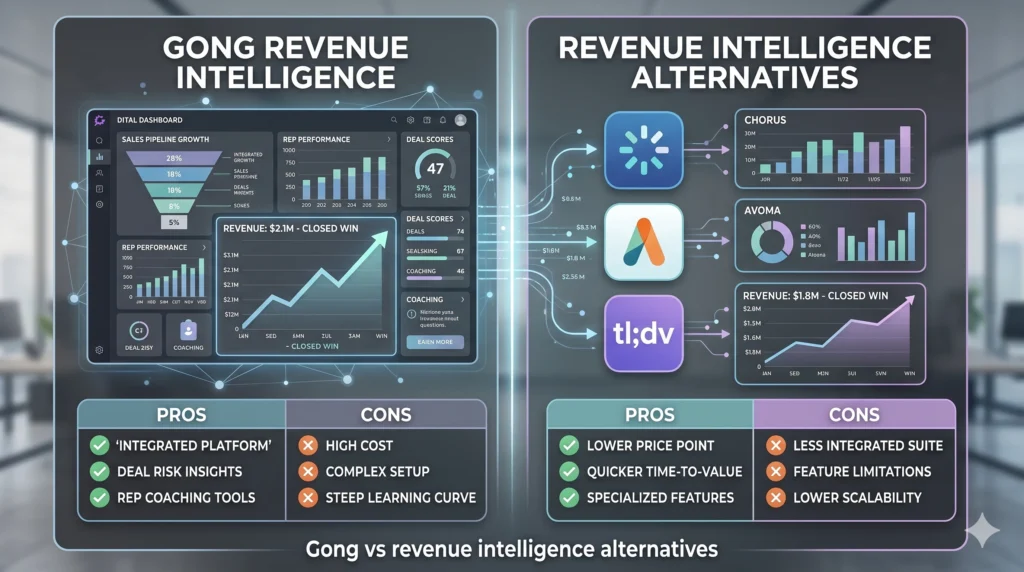
Gong’s direct competitors in the conversation intelligence space include Chorus by ZoomInfo, Clari for forecasting, and newer entrants like Avoma and tl;dv.
Chorus is generally 20 to 30 percent cheaper than Gong and integrates tightly with ZoomInfo’s contact database. Gong’s AI analytics are deeper and its deal intelligence is more sophisticated, but for teams that don’t need all of that depth, Chorus is a reasonable alternative.
tl;dv offers AI meeting transcription and basic coaching starting at zero cost per month. It’s nowhere near Gong’s level for deal intelligence and forecasting, but for teams that only need call recording and summaries, paying $1,600 per user per year for Gong is genuinely hard to justify.
Avoma provides conversation intelligence plus meeting scheduling features at $49 per user per month, which is a fraction of Gong’s cost. It’s less capable on the deal tracking and forecasting side.
Clari focuses more on revenue forecasting than conversation intelligence. Some organizations run Clari alongside Gong rather than choosing between them, though that combination gets expensive quickly.
The category itself has shifted. Gong was genuinely building something new when it launched in 2015. In 2026, the core idea of recording and analyzing calls has been replicated at multiple price points. Where Gong still leads is in the depth of deal intelligence, the quality of coaching tools, and the breadth of integration with enterprise stacks.
Gong Review: Who Should Buy It and Who Probably Shouldn’t
Being straightforward about this saves time for everyone.
Gong makes sense if your team has 50 or more sales reps running complex B2B deals, your average contract value is high enough that saving even a handful of deals per year justifies the platform cost, and you have someone, whether a RevOps leader or sales enablement manager, dedicated to actually building coaching programs and using the data systematically.
It makes less sense if your team is under 20 people, you’re still figuring out your sales process and ICP, your deals are relatively transactional, you run on HubSpot and need deep CRM integration, or the idea of a multi-year six-figure contract with limited exit options gives you pause.
Several reviewers noted that Gong also doesn’t help teams that don’t have enough conversations happening. If your pipeline is thin and reps aren’t booking calls regularly, conversation intelligence can’t analyze what isn’t there.
Conclusion
After going through all of this, the honest answer to whether Gong is the best revenue intelligence platform in 2026 is: it depends on who’s asking.
For large B2B enterprise teams with complex sales cycles, substantial budgets, and a real commitment to using the data it generates, Gong is still the most capable option in its category. The conversation analytics are deep, the deal intelligence is genuinely useful, and the coaching tools, when actually used, produce measurable improvements in rep performance. Users on G2 consistently give it a 4.7 out of 5. That rating reflects real satisfaction from teams that have set it up properly and staffed it appropriately.
For teams at smaller scale, the pricing structure, the buying experience, and the HubSpot integration gaps create real friction that the product’s capabilities don’t always offset.
If you’re seriously evaluating Gong as part of your B2B sales stack in 2026, the best first step is to have a clear list of the specific problems you’re trying to solve before you get on a call with their team. Something like: “We lose track of deal risk across a 90-day sales cycle” or “We can’t tell why our top rep closes 40 percent more than everyone else.” That clarity will help you figure out quickly whether Gong’s specific features map to those problems, and it’ll make the pricing conversation go better too. Go in knowing what you need, not just what the demo shows.
If you want to learn how to experiment with AI prompts and build with Gemini, check out this beginner‑friendly guide:
Google AI Studio: A Beginner’s Guide to Building with AI – SaaslyAI