
The Bill Nobody Saw Coming
Last quarter, a mid-sized logistics company did an audit of their software spending. What they found surprised even their own IT team.
They had 47 active SaaS subscriptions. Their finance team knew about 31 of them. The other 16 had been signed up by individual departments – sometimes by individual employees – without going through any formal approval process. Together, those 16 tools were costing the company over $400,000 a year.
Nobody had approved that spend. Nobody was tracking whether those tools were delivering any value. And because the costs were spread across dozens of small monthly invoices, nobody had noticed how much it all added up to.
This is the reality of AI SaaS governance in 2026 – or rather, the lack of it. And that logistics company is far from unique.
Right now, across companies of every size, AI tools are being adopted faster than any governance structure can keep up with. The costs accumulate quietly. The value is assumed but rarely measured. And finance and IT teams are left managing a sprawling, constantly expanding stack of tools they do not fully understand or control.
This is the problem we need to talk about.

What Is Shadow SaaS – And Why Is It Getting Worse?
You have probably heard the term shadow IT – the phenomenon where employees use technology tools that the IT department did not approve and does not know about. It has existed for years.
Shadow SaaS is the same thing, but specific to software subscriptions. A team lead signs up for an AI writing tool using a company credit card. A developer subscribes to an AI code review platform with their personal card and files for reimbursement. A sales team starts using an AI prospecting tool that a vendor offered them on a free trial – which quietly converted to a paid subscription three months later.
None of these decisions are malicious. In fact, most of them come from a genuinely good place. Employees see a tool that makes their job easier and they go get it. That is actually a healthy instinct.
But from a governance standpoint, it creates real problems.
IT does not know these tools exist, so they cannot assess the security and data privacy implications. Finance does not know they are being paid for, so they cannot track ROI or manage the spending. Leadership cannot get an accurate picture of what the company’s AI capabilities actually are – or what they are costing.
And in 2026, with the sheer volume of AI tools available and the ease with which anyone can sign up for them, shadow SaaS has grown into something that no company can afford to ignore.
The Invisible Workforce Nobody Is Accounting For
Here is the thing that makes AI SaaS governance uniquely different from managing traditional software.
When you hire an employee, the cost is very visible. It shows up on the payroll report. HR tracks it. Finance budgets for it. Leadership sees it in headcount numbers. There are clear processes for approving new hires, onboarding them, measuring their performance, and offboarding them when they leave.
AI tools are doing many of the same things that employees used to do. They are generating documents. They are responding to customer service tickets. They are writing code. They are analyzing data and producing reports. They are scheduling, summarizing, translating, and organizing.
But the cost of this AI work does not show up on a payroll report. It shows up in SaaS invoices – often buried in usage line items that nobody reads closely. It accumulates silently, month after month, without the same visibility or accountability that human headcount receives.
Think about what that means practically. A company might have an AI customer service agent handling 10,000 support tickets a month. That is work that previously required a team of human agents. The value is real. But is anyone tracking whether the cost of the AI agent is actually less than what the human team would have cost? Is anyone measuring the quality of the AI responses compared to what humans were producing? Is anyone asking whether the money being spent on that tool is the best use of those dollars?
In most companies right now, the honest answer is no.
The AI is doing the work. The invoice is being paid. But the governance layer – the part that asks whether this is working, whether it is worth it, and whether we are managing it well – is simply missing.
Why Visibility Is So Hard to Get
If you have tried to build a clear picture of your company’s AI SaaS spending and gotten frustrated, you are not struggling because you are doing something wrong. The problem is genuinely hard, and here is why.
The tools are everywhere
AI capabilities are no longer just in dedicated AI tools. They are embedded inside tools your company already uses for other purposes. Your CRM probably has AI features now. Your email platform has AI. Your project management tool has AI. Your document editor has AI.
Some of these features are included in your existing subscription. Some cost extra based on usage. Some are being used heavily by your team and some are turned on but ignored. Unpicking which AI features are active, which are generating costs, and which are delivering value requires going tool by tool – and most companies have a lot of tools.
Costs are fragmented
AI SaaS spending rarely sits in one budget line. It might be split across IT budgets, department budgets, individual expense reports, and corporate credit card statements. No single person has the full picture because no single place holds all the information.
Usage data is locked inside each vendor’s platform
You can see your own usage data – but only inside each individual tool’s dashboard. Getting a consolidated view across all your AI tools requires either manual effort to pull reports from each platform, or investing in a dedicated SaaS management platform that aggregates everything in one place.
Things change fast
An AI tool that your team used lightly six months ago might be the most-used tool in your stack today. Pricing structures get updated. New AI features get added to existing subscriptions. Teams that were not using a tool start using it heavily. The landscape shifts constantly, which means any visibility you build today requires ongoing maintenance to stay accurate.
The Real Risks of Poor Governance
Getting a handle on AI SaaS governance is not just about saving money, though the financial case is strong. There are several other categories of risk that companies are exposed to when they do not have proper oversight of their AI tools.
Security and data privacy
Every AI tool that your employees are using potentially has access to your company’s data. Documents uploaded for summarization. Customer records analyzed for insights. Emails processed for tone and clarity. Code reviewed for quality.
If IT does not know a tool exists, IT cannot assess whether that tool’s data handling practices meet your company’s security standards. It cannot check whether the vendor has appropriate data processing agreements in place. It cannot ensure the tool complies with GDPR, HIPAA, SOC 2, or whatever regulations apply to your industry.
Shadow AI tools are a data breach waiting to happen for companies that are not paying attention.

Compliance and legal exposure
In regulated industries – finance, healthcare, legal, insurance – the stakes of unsanctioned AI tool usage are even higher. Using an AI tool that processes customer data without proper legal agreements in place can expose a company to significant regulatory penalties.
And this is not hypothetical. Regulators in multiple jurisdictions have become significantly more focused on AI governance in 2025 and 2026. The question of whether a company can demonstrate oversight and control over how AI is used in its operations is increasingly being asked.
Duplicate spending
When different teams independently adopt AI tools without central visibility, they very often end up paying for tools that do the same thing. The marketing team uses an AI writing tool. The sales team uses a different AI writing tool. The customer success team has a third one. Each costs money. Each requires maintenance. And none of the teams knows the others are paying for essentially the same capability.
Consolidating duplicate tools is often one of the fastest ways to generate cost savings once a proper audit is done.
The ROI question
Perhaps the most fundamental governance issue is this: nobody is measuring whether the AI tools are actually working.
Spending on AI is justified by promises of productivity gains, cost savings, and better outcomes. Those promises are often real. But they need to be measured. If an AI tool costs $80,000 a year and delivers $200,000 in productivity benefits, that is an excellent investment. If it costs $80,000 a year and the team that uses it cannot articulate a single concrete benefit, that is $80,000 that should be going somewhere else.
Without governance, there is no framework for making that assessment. Tools renew automatically. Spending continues. And the question of whether any of it is working never gets properly asked.
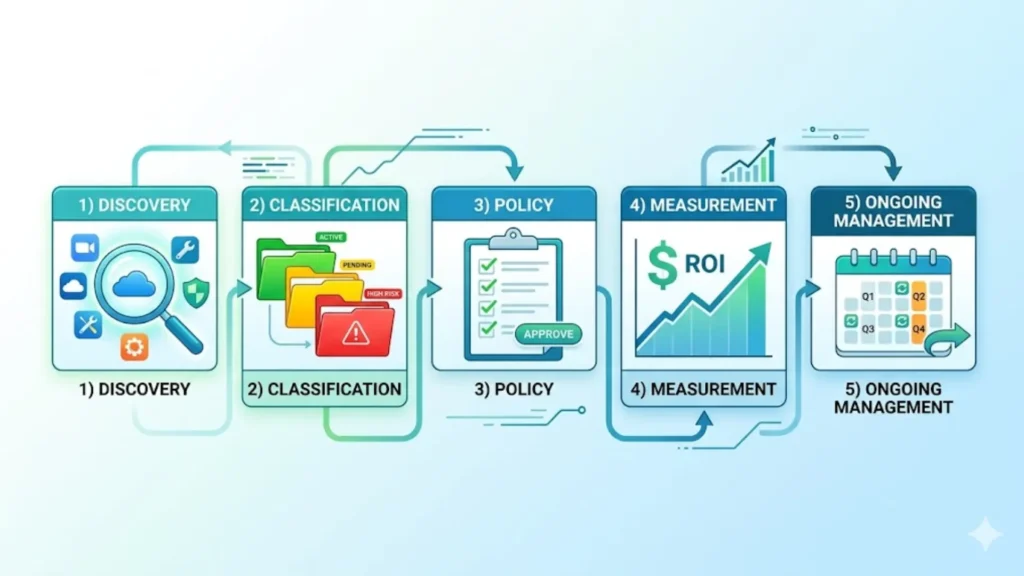
How to Build a SaaS Governance Framework for AI Tools
The good news is that you do not need to build something complex to start getting control. A practical governance framework for AI SaaS can be built in stages, starting with the basics and adding sophistication over time.
Stage 1 – Discovery (Know What You Have)
Before you can manage anything, you need to see everything. Run a full audit of your SaaS stack. Look at corporate credit card statements. Talk to department heads. Survey employees. Use a SaaS discovery tool if you have one, or go through your identity provider to see which third-party applications have been granted access.
Build a master list of every AI tool the company is using or paying for. For each one, capture the vendor name, the cost, who is using it, what it is being used for, and who approved it.
This exercise alone is almost always eye-opening. Most companies discover tools they forgot they were paying for, tools that nobody is using anymore, and significant duplication.
Stage 2 – Classification (Sort What You Have)
Once you have a complete list, classify each tool into one of a few categories:
- Essential and approved – Core tools that are actively used, delivering clear value, and have gone through proper security and legal review. These stay.
- Active but not reviewed – Tools that teams are using but that have not been properly vetted for security, compliance, or value. These need to go through a review process.
- Redundant – Tools that duplicate capabilities that other approved tools already provide. These are candidates for consolidation.
- Unused or underused – Tools that are being paid for but not meaningfully used. These are candidates for cancellation.
This classification gives you a clear picture of where to focus first.
Stage 3 – Policy (Define How New Tools Get Approved)
Governance without a clear process for adding new tools just means you audit yourself back into chaos six months later.
Define a lightweight approval process for new AI tool requests. It does not need to be bureaucratic – the goal is visibility and basic review, not months of procurement process. Something simple works well: any new AI tool above a certain spending threshold requires a quick review covering the cost, the security implications, the data handling practices, and the business case.
Make it easy for employees to submit requests. Make the review process fast – a week or two, not months. And communicate clearly that using unauthorized AI tools with company data is against policy and why.
Most employees will follow a clear, reasonable process. It is the absence of any process that creates shadow SaaS, not a desire to circumvent the rules.
Stage 4 – Measurement (Track Whether It Is Working)
For each essential AI tool in your stack, define what value looks like. What metric would tell you this tool is worth what you are paying? Time saved per week? Tickets resolved per agent? Documents processed per hour? Revenue influenced?
You do not need perfect measurement. You need enough measurement to have a meaningful conversation at renewal time about whether to continue, expand, or replace the tool.
Build this into your renewal process. Sixty days before any significant AI tool contract renews, pull the usage data and whatever value metrics you have been tracking. Make a deliberate decision. Do not just let it auto-renew by default.
Stage 5 – Ongoing Management (Keep Up With the Pace of Change)
AI tools evolve fast. A tool that was the right choice twelve months ago might have been surpassed by something better. A vendor that had solid security practices might have had a breach or changed their data handling policies. A team that was a heavy user might have shifted workflows and no longer needs the tool.
Schedule a quarterly review of your AI SaaS stack. Not an audit – those are painful and infrequent. Just a regular rhythm of checking in: what has changed, what is working, what needs attention.
The companies that manage this well treat it like any other ongoing operational discipline. It is not a project with an end date. It is just part of how they run their business.
What Good AI SaaS Governance Actually Looks Like
Let me paint a picture of what this looks like when it is working well, because it is not actually that complicated.
A team lead at a well-governed company wants to try a new AI research tool. They submit a simple request through the IT portal – tool name, cost, what it does, what business need it addresses. IT checks the security and data handling basics. Finance confirms the budget. The approval comes back in a week.
The tool gets added to the company’s SaaS management platform, which tracks usage automatically. The team lead gets a monthly summary of what their team is spending on AI tools. At the end of the quarter, when the IT team runs its regular review, they can see the tool is being actively used and the team lead has reported measurable time savings. Easy decision to keep it.
Six months later, a different team submits a request for a tool that does essentially the same thing. IT catches the duplication, connects the two teams, and suggests they evaluate whether one tool can serve both. It can. One subscription gets cancelled. Money saved. Nobody had to do a painful audit to find that.
That is what good governance looks like. Not a bureaucratic nightmare. Just visibility, simple processes, and regular check-ins.
Quick Summary
- Shadow SaaS – AI tools adopted by teams without central oversight – is growing faster than most companies realize and creating real financial, security, and compliance risks.
- AI tools are doing work that used to require human employees, but unlike headcount, those costs accumulate silently in SaaS invoices without the same visibility or accountability.
- Poor AI SaaS governance creates risks across four areas: security and data privacy, regulatory compliance, duplicate spending, and inability to measure ROI.
- Building a governance framework does not have to be complex – start with discovery, classify what you have, define an approval process, build in measurement, and keep reviewing regularly.
- The goal is not to slow down AI adoption. It is to make sure the AI tools your company is paying for are the right ones, properly reviewed, and actually delivering value.
Does your company have a formal process for approving and tracking AI tools? What has worked – or not worked – in your experience? Share in the comments.