Artificial intelligence is moving at a quick rate as we enter 2026. From machine learning algorithms driving autonomous systems to technologies changing creative industries, artificial intelligence is now accessible to everyone, not only to major corporations as it used to be.
This provides an exciting opportunity for beginners to learn fundamental skills even without having a computer science degree or advanced math knowledge. There is a rapid increase in demand for individuals with AI understanding; roles such as prompt engineering, AI ethics, data analysis, and leveraging AI in business are projected to expand substantially.
This is a detailed review of the top 10 AI courses for beginners in 2026. We have chosen free and paid options from well-known platforms like Coursera, Google, DeepLearning.AI, etc., so there is something for everyone.
These courses were picked based on how easy they are to get into, who teaches them (including stars like Andrew Ng), practical parts of the course, feedback from learners, and how well they fit with new trends such as generative AI and responsible practices in AI. Most of these come with certificates that can help you when looking for a job.
These courses provide clear pathways to artificial intelligence for those who are looking to pick up a new skill at work, deciding on their future career as a student or simply getting curious about learning. You will get the opportunity of flexible time schedules, actually doing the work, and experiencing ways that tie directly to life outside the classroom.
The Growing Importance of AI Skills in 2026
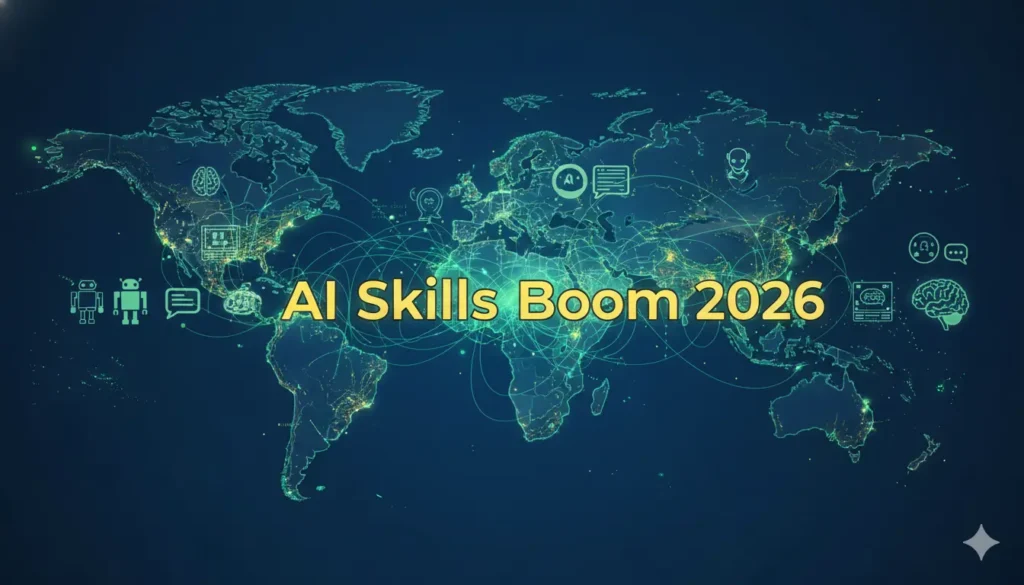
AI is set to bring benefits to the global economy, which will amount to trillions by 2026. Large language models and multimodal AI are being used in everyday workflows, such as content creation and business decision, making. At first, it is good to understand the non, technical aspects of AI’s capabilities and limitations before gradually moving on to the technical aspects, such as coding or prompt engineering.
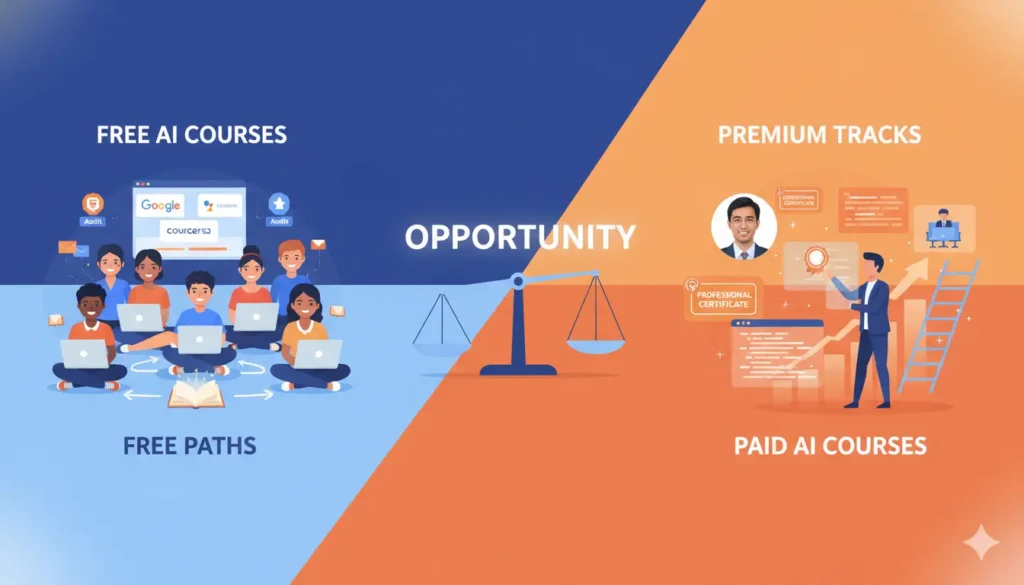
Free courses are the gateway for anyone to try out different approaches, while paid courses provide structured depth, projects, and credentials that can be verified. With no prerequisites save for fundamental computer skills, the majority of these classes require just 5 to 15 hours of your time per week. With artificial intelligence education, one’s problem-solving, ethical reasoning, and creativity increase – these are the traits much sought for in marketing, healthcare, education, and banking sectors.
Top 10 AI Courses for Beginners in 2026
As we step into 2026, AI is developing at a breathtaking pace. AI for generating, ethics of AI, and application of AI have been incorporated into most fields. A beginner can now access excellent learning resources without needing any background knowledge in coding or advanced math. AI learning is now more inclusive than it had ever been before. Here is a compilation of
The top 10 courses available for a beginner were via reliable online resources and AI experts. The focus was accessibility and popularity toward the end of 2025.
1. AI For Everyone by Andrew Ng (DeepLearning.AI on Coursera) – Free to Audit
This beginner-friendly course is great for people without prior knowledge. Delivered by AI guru Andrew Ng it covers AI ideas, their application in society and business, limits, and ethical issues without any coding or mathematical skills needed. Participants learn how artificial intelligence operates in circumstances such as automation and decision-making processes and find how to recognize artificial intelligence opportunities in their own work. Usually finished in a few hours, the course is both engaging and motivating with videos and tests. Millions have signed up, appreciating its simplicity and capacity to generate enthusiasm for more education. Free to audit; option for a paid certificate.
- Key Topics: machine learning processes, data bias, ethical problems, and creating artificial intelligence projects in companies; applications in the actual world; and AI vocabulary;
- Duration:Over four modules spanning around six to ten hours.
- Why Newbies Should Rely On Ng’s Clear Descriptions: Ng breaks down complex topics into simple explanations, making them really easy to understand. Through the course, you will learn what AI is capable of (and its limitations) which will help you see the opportunities in your life or work. Millions of people have completed it and it is truly very motivating.
- Cost: free to audit (access all content); paid for certificate (~$49).
- Platform : Coursera
2. Google AI Essentials (Google on Coursera) – Free with Certificate
Especially created for beginners, this course from Google specialists presents generative artificial intelligence tools and real-world applications. It spans basic ideas, good prompt writing, ethical artificial intelligence techniques, and including artificial intelligence into daily tasks for productivity. Hands-on exercises enable students to explore Google’s capabilities like Gemini and get quick results in content generation, brainstorming, or problem-solving. It includes a certificate upon completion and demands no prior experience. In many areas, it is entirely free; thus, an easy way to use artificial intelligence right now is through it.
- Key Topics: Basics of generative AI, prompt engineering, AI workflow integration, responsible AI concepts, and using tools such as Gemini for productivity Self, paced, fewer than ten hours.
- Hands-on with Google’s own tools with no prior expertise necessary makes it perfect for beginners. Seeing instant results, you will develop cues for activities like summary or brainstorming.
- Free; certificate is included.
- Platform: Grow with Google and Coursera.
- Perfect for experts looking for fast victories in daily activities.
3. Generative AI for Everyone by Andrew Ng (DeepLearning.AI on Coursera) – Free to Audit
Building on fundamental knowledge, this course examines generative artificial intelligence including how models like ChatGPT operate, prompt engineering strategies, practical uses, and possible hazards such as biases or hallucinations. Clear examples and hands-on cues help Andrew Ng demonstrate creative increases in writing, code, or design. Non-technical yet educational, it enables newcomers to grasp the underlying technologies driving the AI tools of 2026. Perfect for people wondering about the generative artificial intelligence boom, free to audit.
- Key Topics: Understanding how LLMs such as ChatGPT work, prompt engineering strategies, use cases for the generation of content, limitations (e. g. , hallucinations), and impact in the future.
- Length: Around 12 hours.
- Why It’s Perfect for Rookies: The course is non, technical and highly informative with many examples and exercises. The theory is well, linked to practice and the course is not overwhelming.
- Price: Free to audit; paid certificate.
- Platform: Coursera.
4. Elements of AI (University of Helsinki & MinnaLearn) – Completely Free
The series that is available at no cost breaks down the essentials of artificial intelligence, defining what it is and what it is not, explaining machine learning concepts, neural networks, and societal impacts such as ethics and employment. It is a wide and gentle introduction to AI.
This course is open to anyone without any background knowledge or skills, as it has interactive activities and a global community for discussion.
It keeps being updated, shifting the attention to the understanding and use of the subject rather than to the details of technology.
The course is free, and you can receive a certificate if you want; it has been taken by over a million students from all over the world.
- Key Topics: Understanding AI, basics of machine learning, neural networks, practical impacts, ethics, and societal changes.
- Duration: 30 or 60 hours across different modules. Why It’s Suitable for Beginners: You don’t need any math or programming skills; also, there are interactive exercises, and you can learn from a friendly community. So, it’s fun and quite detailed.
- Cost: Free; certificate is available for purchase.
- Platform: elementsofai.com.
- More than 1 million people have completed this course, making it very good for a holistic understanding.
5. Introduction to Generative AI (Google Cloud Skills Boost) – Free
Google provides a short, free micro, course that highlights the core principles of generative AI. It explains the differences between traditional artificial intelligence, large language models, application scenarios, and ethical conduct. The modules are quick and easy to digest, and include practical exercises based on the Google ecosystem. Ideal as a one, off introduction or addition to broader courses.
- Key Topics: Differences between traditional and generative AI, LLMs, ethical considerations, and basic use cases.
- Duration: 4-6 hours.
- Why It’s Ideal for Beginners: Bite-sized modules with quizzes; integrates Google tools.
- Cost: Free.
- Platform: Google Cloud.
- Perfect quick supplement.
6. Machine Learning Specialization by Andrew Ng (Coursera) – Paid Subscription
For novices who are willing to delve into technical matters, this refreshed specialization conveys main machine learning concepts through Python projects. It covers supervised and unsupervised learning, neural networks, along with best practices. At first, the course is smooth, gradually developing skills through labs in tools such as TensorFlow. It is the reference point for the core technical AI knowledge and is very highly rated for Ng’s presentation style. You have to pay for a subscription if you want to get full access and a certificate.
- Key topics: Supervised and unsupervised learning, neural networks, recommendation systems, and best practices for Python projects.
- Duration: 3 months (10 hours/week).
- Why it’s great for beginners: Starts right from basics, assuming almost no coding knowledge. The interactive labs made it really easy for me to deeply understand the concepts.
- Price: Coursera subscription (~$49/month).
- Platform: Coursera.
- A go, to foundation for any AI professional in the making.
7. IBM AI Developer Professional Certificate (Coursera) – Paid
This IBM introductory course covers ethics, applications in business, kinds of machine learning, and history of artificial intelligence in a well balanced perspective. Demos and basic exercises are among its components that help to clarify ideas without extensive code. Good for grasping the wider picture of artificial intelligence, dependable perspective from a large tech company. Free for audit.
- Major Areas: Python programming for artificial intelligence, fundamental deep learning concepts, generative AI, computer vision, ethical considerations, and final projects.
- Time: 4, 6 months.
- Beginner, friendliness: Detailed instruction on the whole journey, from introductory material to developing portfolio, building apps.
- Charge: Coursera subscription.
- Where: Coursera.
- Good line of work changer.
8. CS50’s Introduction to Artificial Intelligence with Python (Harvard on edX) – Free to Audit
Harvard’s often taken Python-based introductory course is project-based and interesting. Through riddles and actual uses such as games or linguistic processing, it spans search algorithms, optimization, machine learning, and neural networks. Welcome to motivated beginners, but presumes rudimentary Python (with resources given). Free to audit with a paid certificate, the course is known for teaching material that is both fun and rigorous and accessible.
- Key Topics: Search algorithms, knowledge representation, optimization, machine learning, and neural networks using Python.
- Duration: 7, 10 weeks. Why It’s Ideal for Beginners: Great lectures, puzzles, and projects; basic Python is assumed (free intro available).
- Cost: Free; paid certificate. Platform: edX.
- A rigorous yet accessible bridge to intermediate levels.
9. Introduction to Artificial Intelligence (IBM on Coursera) – Free to Audit
On Coursera, IBM’s Introduction to Artificial Intelligence stands apart as an entry-level artificial intelligence course for those keen to grasp basic concepts without technical strain. Designed for people without coding knowledge and beginners, this course suits professionals, newcomers, and students alike.
The course defines artificial intelligence, its functioning, and its everyday uses. In plain words, you will investigate artificial intelligence subjects including machine learning, deep learning, natural language processing (NLP), computer vision and chatbots. Real-life examples from technology, corporate, banking, and healthcare help IBM experts to guarantee the learning process is simple to grasp and realistic.
One big advantage of this course is that it demands neither arithmetic nor coding expertise. Videos, quizzes, and real case studies are used to teach newcomers concepts and help them develop a thorough grasp. Furthermore, the course addresses how elements of artificial intelligence lead pupils toward moral application of it.
This course gives you free access to all resources and lets you audit it at no cost. You have the option to upgrade to the paid edition should you want a certificate attested by IBM and Coursera.
Any one wishing a straightforward, reliable introduction to artificial intelligence and planning future advanced AI or machine learning classes would find this one ideal.
- Key Topics: AI history, types of machine learning, applications in industries, ethics, and demos.
- Duration: 8-12 hours.
- Why It’s Ideal for Beginners: Theory with practical insights and examples.
- Cost: Free to audit.
- Platform: Coursera.
- Reliable corporate perspective.
10. Generative AI with Large Language Models (DeepLearning.AI on Coursera) – Paid
Generative AI with Large Language Models by DeepLearning.AI on Coursera is a hands-on and industry-oriented course designed for those eager to learn how contemporary AI technologies such as ChatGPT, Gemini and other LLMs function in reality. This course is ideal for beginners having AI understanding, as well, as students and professionals looking to enter the field of generative AI.
The course covers the training, tuning and deployment of large language models through practical workflows. You will explore transformer architectures, prompt engineering, instruction tuning, reinforcement learning with feedback (RLHF) and the assessment of LLMs in an accessible and organized manner. The material is presented with explanations simplifying intricate concepts, for easier understanding.
A key feature of this course is its practical methodology. Participants engage with examples like text creation, summarizing, answering questions, chatbots and AI-enhanced applications. Additionally the curriculum addresses AI safety concerns and the constraints of large language models, which is essential, in the current AI-centric environment.
To access the full course contents like video lessons, quizzes, practical exercises and be able to get a professional certificate from DeepLearning. Coursera, the course needs to be paid for. The credential can be a major boost to your resume especially if you are aiming at roles in AI, data science or software engineering.
In general, this course is a very good option for anyone who wishes to have a strong grounding in generative AI and large language models and also keep up with the fast, changing AI scene of 2026.
- Key Topics: Training, fine-tuning, evaluation of LLMs, advanced prompt engineering, and real labs.
- Duration: 3 weeks.
- Why It’s Ideal for Beginners: Assumes basic ML; focuses on cutting-edge techniques with projects.
- Cost: Coursera subscription.
- Platform: Coursera.

Conclusion
Studying AI in 2026 is of utmost importance and is a strong commitment to your future.
Once AI becomes a part of every sector it’s thoroughly newcomers have a great opportunity to start early and grow highly valuable, in, demand skills.
These 10 AI courses selected in this post provide a mixture of free and paid alternatives so that anyone can start learning with or without a budget or prior knowledge.
Paid programs deliver a learning path, hands, on projects, certificates, and job support, while free courses are perfect for getting a grasp of artificial intelligence basics, machine learning concepts, and application.
If you are looking for a job, want to change a career, do freelance, or simply understand how artificial intelligence works, there is a course for you.
Frequently Asked Questions (FAQs)
1.What are the best AI courses for beginners in 2026?
The top AI courses for beginners in 2026 include both paid and free options from well, known providers like Coursera, edX, Udemy, Google, IBM, and DeepLearning. AI. These courses teach essential AI concepts, machine learning, and generative AI without the need for advanced skills.
2. Can a beginner learn AI without coding knowledge?
Yes, beginners can start learning artificial intelligence without programming. Many artificial intelligence courses begin with fundamental ideas, practical examples, and theory. Though it is beginning-friendly, some programs gradually introduce basic coding later on.
3. Are free AI courses good for beginners?
Beginners certainly gain much from free artificial intelligence courses. High-quality material is available on Coursera (free audit), Google, and IBM. Understanding fundamental ideas before turning to paid courses is best achieved via free courses.
4. What is the difference between free and paid AI courses?
Usually, free artificial intelligence courses offer limited access, especially if you don’t have a certificate. Paid artificial intelligence courses provide certification, projects, assignments, mentorship, and lifetime access. Regardless, both have the potential to be beneficial depending on your objectives.
5. Which AI course is best for students?
Such beginner level lessons as Introduction to Artificial Intelligence (IBM) and AI for Everyone by Andrew Ng are perfect for pupils. These courses are comprehensible and explain artificial intelligence in very simple terms.